

'/%3E%3C/svg%3E)
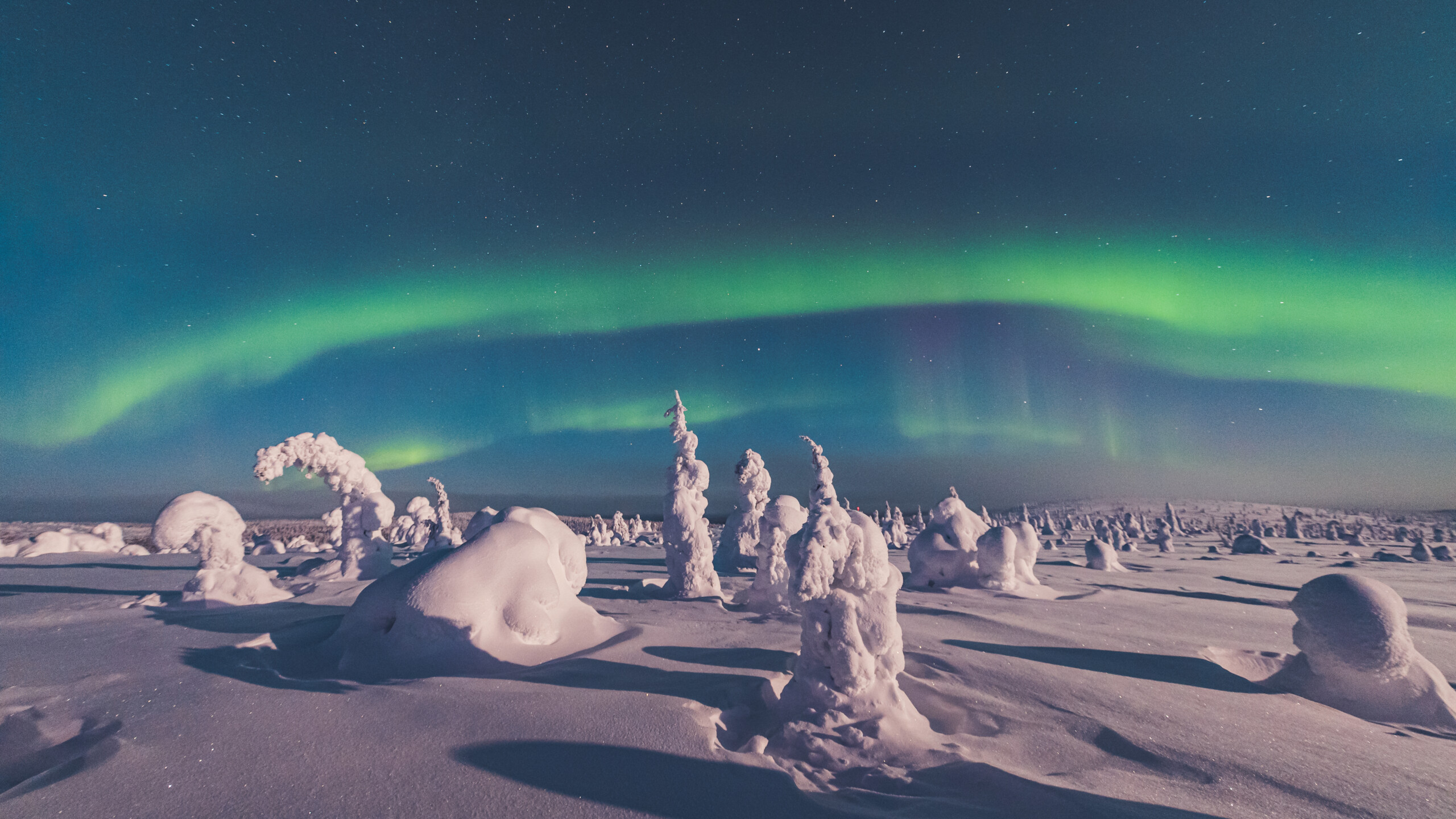



The northern lights, or aurora borealis, form when charged particles from the sun collide with gases in Earth’s upper atmosphere. These collisions release energy as light, creating the glowing curtains and ribbons visible in the night sky. The process is driven by the sun’s activity and shaped by Earth’s magnetic field, which channels the particles toward the polar regions.
The result is one of the most visually striking natural phenomena on the planet, and understanding how it works makes the experience even more rewarding. Below, we break down the science behind the aurora borealis northern lights phenomenon, from the colours it produces to the best conditions for seeing it.
How does Earth’s magnetic field create the aurora display?
Earth’s magnetic field acts like a giant funnel, directing charged solar particles toward the polar regions where they enter the atmosphere and trigger the aurora. Without this magnetic shield, the particles would be deflected or scattered randomly, and the northern lights as we know them would not exist.
The sun constantly releases a stream of charged particles called the solar wind. When this wind reaches Earth, most of it is deflected by our planet’s magnetosphere. However, near the magnetic poles, the field lines converge and dip toward the surface, creating openings where particles can travel down into the upper atmosphere at altitudes of roughly 100 to 300 kilometres.
What is the auroral oval?
The auroral oval is a ring-shaped zone encircling each magnetic pole where aurora activity is most concentrated. It sits roughly between 65 and 72 degrees latitude in the Northern Hemisphere. Locations that fall within or near this oval, including Northern Finland, are statistically the best places on Earth to observe the northern lights.
How does solar activity affect the display?
The strength and frequency of aurora displays are closely tied to the sun’s 11-year activity cycle. During periods of high solar activity, the sun produces more intense bursts of energy called coronal mass ejections, which send larger clouds of charged particles toward Earth. When these hit our magnetosphere, they compress it and allow particles to penetrate deeper into the atmosphere and further from the poles, producing stronger and more widespread aurora displays.
What makes the northern lights different colours?
The colours of the northern lights depend on which atmospheric gas the solar particles collide with and at what altitude the collision occurs. Oxygen and nitrogen each produce distinct colours, and the height of the collision determines which colour dominates in any given display.
- Green is the most common colour, produced by oxygen at altitudes of around 100 to 150 kilometres. It is the colour most people associate with the aurora.
- Red appears at higher altitudes, above 200 kilometres, where oxygen is less dense and collisions are less frequent. Red auroras are rarer and often only visible during intense solar events.
- Blue and purple tones come from nitrogen molecules at lower altitudes, typically below 100 kilometres.
- Pink fringes sometimes appear at the lower edges of green auroras where nitrogen mixes with the oxygen-driven light.
The intensity of the colour also depends on how energetic the incoming particles are. A stronger solar event delivers more energetic particles, which can produce more vivid and varied colours across a wider band of the sky.
Why do the northern lights move and dance in the sky?
The northern lights move because the flow of charged particles from the sun is not steady or uniform. Fluctuations in the solar wind and shifts in Earth’s magnetic field cause the aurora to ripple, swirl, and change shape in real time, sometimes dramatically within seconds.
The movement follows the behaviour of the particles themselves as they spiral along magnetic field lines. When the solar wind intensifies or changes direction, it pushes and distorts the magnetosphere, and the aurora responds immediately. This is why a quiet, diffuse glow can suddenly erupt into rapid curtains of light sweeping across the sky.
Geomagnetic substorms are a key driver of the most dramatic aurora motion. During a substorm, energy stored in Earth’s magnetotail is suddenly released, sending a surge of particles into the upper atmosphere. The result is rapid brightening and rapid movement that can last anywhere from a few minutes to an hour. These substorms happen independently of the overall level of solar activity, which means dramatic aurora displays can occur even on nights when the overall aurora forecast is moderate.
When and where are you most likely to see the northern lights?
You are most likely to see the northern lights between late August and early April, in locations within or near the auroral oval, on clear nights away from light pollution. The peak months are September, October, February, and March, when long nights and statistically clearer skies combine to give the best viewing conditions.
Darkness is a basic requirement. Because the aurora is a relatively faint light source, it is invisible during daylight hours or in bright twilight. This means the viewing season is limited to the months when nights are long enough at high latitudes. Midsummer, when the sun barely sets in the far north, is not suitable for aurora viewing regardless of solar activity.
What conditions give you the best chance?
Three factors determine whether you will see the northern lights on any given night:
- Solar activity: Measured using the Kp index, which runs from 0 to 9. A Kp of 3 or above is generally enough to see aurora from locations like Ruka in Northern Finland. Values of 5 and above produce displays visible further south.
- Clear skies: Cloud cover is the most common reason people miss the aurora. Checking a local weather forecast alongside the aurora forecast is just as important as the Kp reading.
- Darkness: Getting away from artificial light dramatically improves visibility. Even a short drive out of a town centre into open countryside or forest makes a real difference.
Why is Ruka-Kuusamo a strong location for aurora viewing?
Ruka-Kuusamo sits in Northern Finland at a latitude that places it directly within the auroral zone. The region has over 200 clear nights per year on average, open wilderness landscapes with minimal light pollution, and a long dark season running from September through April. These conditions combine to make it one of the most reliable places in Europe to witness the aurora borealis. The surrounding forests and frozen lakes also create a natural backdrop that adds to the experience of watching the lights appear overhead.
If you want to maximise your chances, consider staying for at least three to five nights rather than a single night. Aurora activity is unpredictable, and a longer stay gives you multiple opportunities to catch a display even if the first nights are overcast.
See the northern lights with Tailored Adventures Rukapalvelu
We are a family-owned destination management company based in Ruka-Kuusamo, with over 35 years of experience organising experiences in this part of Northern Finland. We know the terrain, the seasons, and the conditions that give you the best chance of seeing the aurora borealis in a setting that feels genuinely wild and remote. This is the spirit of Farnorth: closer than you think, wilder than you imagined.
When you travel with us, we take care of the details so you can focus on the experience:
- Guided aurora-hunting excursions into the wilderness, away from light pollution
- Accommodation options from Hotel Arctic Zone to remote log villa Portin Vartijan Maja
- Combined winter activity packages including snowmobiling, husky safaris, and reindeer experiences
- Tailored programmes for individuals, groups, and corporate incentive trips
Whether you are planning your first trip north or returning for another winter season, we build your experience around what matters most to you. Explore our winter activities in Ruka-Kuusamo and start planning your aurora adventure with us.