


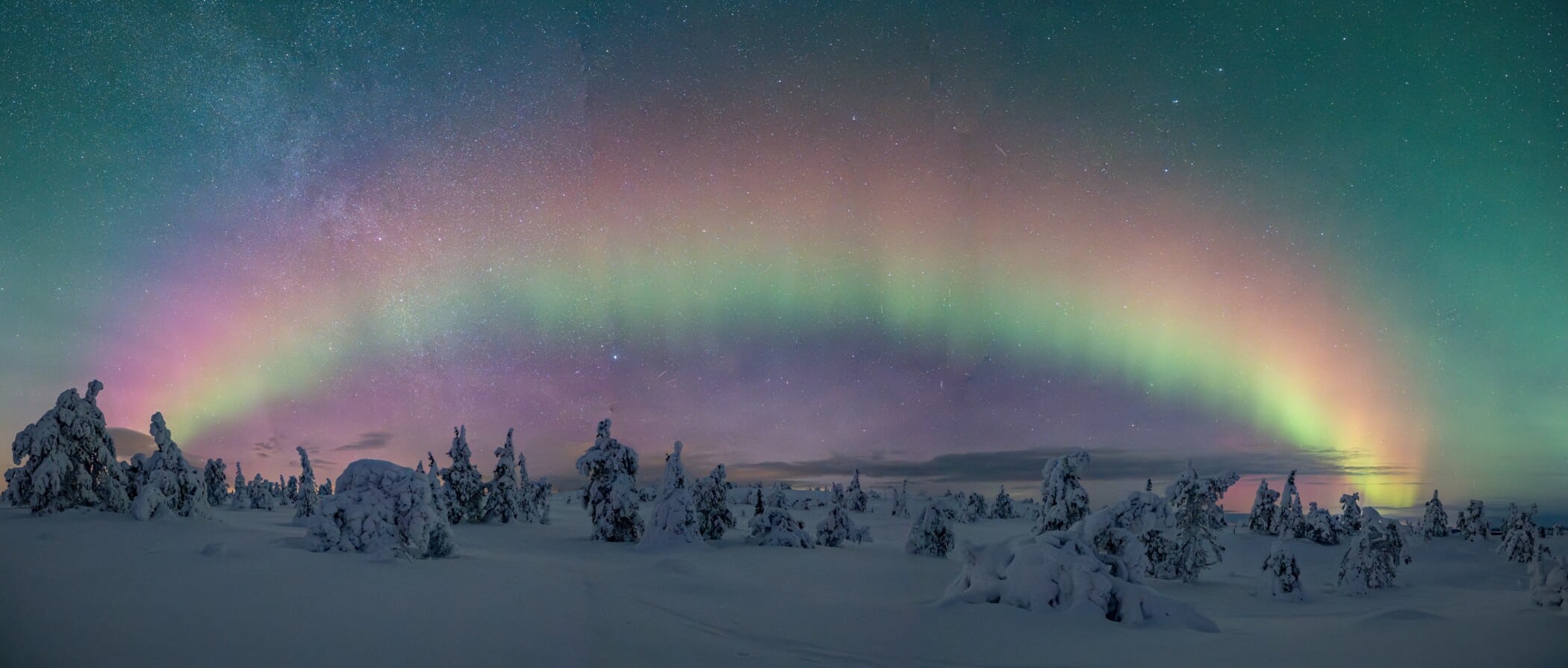



The northern lights appear in different colors because of the way solar particles interact with different gases in Earth’s atmosphere at different altitudes. The specific color you see depends on which gas is being energized and how high up that reaction takes place. Below, we break down the science behind each aurora color and what it tells you about the sky above.
Why do the northern lights appear in different colors?
Northern lights appear in different colors because solar wind particles collide with different atmospheric gases at different altitudes, and each gas releases a specific wavelength of light when energized. Oxygen and nitrogen are the main players, and the altitude of the collision determines which color gets produced. The result is a natural light show with a surprisingly precise scientific explanation.
When charged particles from the sun travel along Earth’s magnetic field lines toward the poles, they slam into gas molecules in the upper atmosphere. That collision excites the atoms, pushing their electrons into a higher energy state. When the electrons drop back down, they release that extra energy as light. The color of that light depends entirely on the type of atom and how far it drops.
Green is by far the most common color, but you can also see red, pink, purple, and blue under the right conditions. Each color corresponds to a specific gas and altitude range. This is not random variation. It is physics working exactly as it should, and once you understand the mechanism, you start to read the aurora borealis northern lights display in a whole new way.
What causes the green color in auroras?
Green is the most common aurora color because it comes from oxygen atoms at altitudes between roughly 100 and 150 kilometers, which is the zone where solar particles most frequently collide with the atmosphere. Oxygen at this height releases green light when its excited electrons return to their ground state, and human eyes are particularly sensitive to this wavelength, making it appear vivid and bright.
The green aurora borealis is what most people picture when they imagine the northern lights, and for good reason. That altitude range sits right in the sweet spot where solar particle density and atmospheric gas density overlap most effectively. The collisions happen frequently, the light output is strong, and the green wavelength at around 557 nanometers lands right where our eyes are most responsive.
Why green appears even in moderate displays
You do not need an exceptionally powerful solar event to see green. Even during relatively mild geomagnetic activity, the oxygen-rich layer at 100 to 150 kilometers produces enough collisions to generate visible green light. This is why green is the default color of most aurora displays and the first one to appear as activity picks up.
How green transitions into other colors
As solar activity increases and particles penetrate deeper into the atmosphere, the green band can shift and intensify. At the lower edge of the green zone, where nitrogen becomes more dominant, you start to see pinkish or purplish fringes at the base of the aurora curtain. At the upper edge, where oxygen is thinner and more widely spaced, conditions start to favor the rarer red color.
What makes red, purple, and blue auroras so rare?
Red, purple, and blue auroras are rare because they require either very high altitudes, very low altitudes, or unusually energetic solar events to produce. Red comes from oxygen above 200 kilometers, an extremely thin part of the atmosphere. Blue and purple come from nitrogen at lower altitudes, where particles need enough energy to reach before being absorbed by denser air.
Red auroras and high-altitude oxygen
Red northern lights are produced by oxygen atoms sitting above 200 kilometers. At that height, the atmosphere is so thin that oxygen atoms can stay in their excited state for much longer before releasing light. When they finally do, they emit a deep red glow. Because the air is so sparse up there, these collisions are relatively rare, and the resulting red aurora is typically faint and visible mainly during strong geomagnetic storms.
Blue and purple from nitrogen
Blue and purple hues come from nitrogen molecules rather than oxygen. Nitrogen tends to produce these colors at lower altitudes, often appearing at the very bottom edge of an aurora display where the curtain meets the horizon. Purple is sometimes a blend of red oxygen light at high altitude and blue nitrogen light at low altitude overlapping in the same visual field. These colors are harder to photograph and harder to see with the naked eye, which adds to their rarity.
Can the color of an aurora predict how strong the display will be?
Aurora color gives you a useful indication of activity level, but it is not a precise predictor of storm strength. Green generally signals moderate activity. Red at high altitude often points to a stronger geomagnetic event. The presence of multiple colors simultaneously, especially red, purple, and blue alongside green, tends to indicate an active and energetic display worth staying outside for.
The KP index, which measures geomagnetic activity on a scale from 0 to 9, is a more reliable forecasting tool than color alone. However, color does give you real-time feedback on what is happening in the sky. If you see the green band suddenly develop red fringes at the top or purple at the base, the activity is likely intensifying. If the display stays uniformly green and steady, conditions are calm but still beautiful.
It is also worth noting that camera sensors pick up aurora colors differently from the human eye. Your camera may show vivid red or purple tones in a display that looks mostly green to you in person. This is because camera sensors are more sensitive to certain wavelengths than our eyes are at night. What you see and what you photograph can be genuinely different, and both are accurate representations of the same physical event.
See the aurora sky with Rukapalvelu
Ruka-Kuusamo sits in Northern Finland, far enough north and far enough from city light pollution to offer excellent aurora viewing conditions from autumn through early spring. This part of the world, where the Far North spirit runs deep, gives you the kind of dark, clear skies where all those colors, green, red, purple, and blue, actually have a chance to show themselves.
We at Tailored Adventures Rukapalvelu organize aurora experiences and winter activities that put you in the right place at the right time. Here is what we offer:
- Guided aurora hunting excursions that take you away from light pollution into open wilderness
- Snowmobile safaris that combine adventure with aurora viewing opportunities
- Husky and reindeer safaris through the winter landscape
- High-quality accommodation at Hotel Arctic Zone and our wilderness lodges, so you can step outside the moment the sky lights up
- Tailored group and individual packages covering transport, activities, and dining
We handle the planning so you can focus on looking up. If you want to experience the northern lights in a region that takes winter seriously, explore our winter activities in Ruka-Kuusamo and start putting your trip together with us.